



VERTICALgarden
We see greenery as a system — modular, flexible, and designed to adapt to different contexts, needs, and functions.
Our solutions transform walls and surfaces into living, integrated elements, bringing nature into architectural spaces in an innovative, customizable, and long-lasting way.


VP MODULO
VP Modulo is the patented modular system by VerdeProfilo® designed for the creation of customized vertical gardens.
Flexible and tailor-made, it is suitable for both indoor and outdoor spaces, offering a wide botanical selection and an integrated automatic irrigation system.
An ideal solution for both public and private environments.
Dimensions

Layout
FULL:

ALTERNATE:

CLIMBING:

ANGULAR:

Certifications
PATENTED:
Modular System for Vertical Gardens | Nov. 2017
LEED® Mapping:
The VP Modulo System has undergone LEED® mapping.
WELL Certification:
WELL is an international rating system that assesses how buildings impact the health and well-being of their occupants.
According to the mapping by Habitech – Trentino Technological District for Energy and Environment, as part of the GREENMAP program, VP Modulo and other VerdeProfilo® products contribute to designing environments that meet WELL standards for people’s physical and psychological well-being.
Our vertical green solutions enhance indoor quality of life — for instance, through the plants’ sound-absorbing properties and their ability to reduce air pollution.
WIND RESISTANCE CERTIFICATION:
The VP Modulo System has been tested for wind load resistance under both positive and negative static pressure, as well as dynamic wind testing with an axial fan.
FIRE CERTIFICATION:
VP Modulo is certified for fire performance according to UNI EN 13501-1:2019, “Fire classification of construction products and building elements – Part 1: Classification based on test results for reaction to fire.”
Download
Accessories
VP MODULO THERMOPINE
VP MODULO TREE POT
VP MODULO BARRIER
Would you like to receive more information?
VP Modulo green wall system: how it is built
VP Modulo is a modular green wall system made of independent elements: aluminum uprights, anchor brackets, adjustable clips, pot holders and modular EPP trays. Each module is fixed individually and, if needed, can be replaced without dismantling the wall. This is what allows ever-changing layouts and the coverage of large surfaces, both indoors and outdoors.
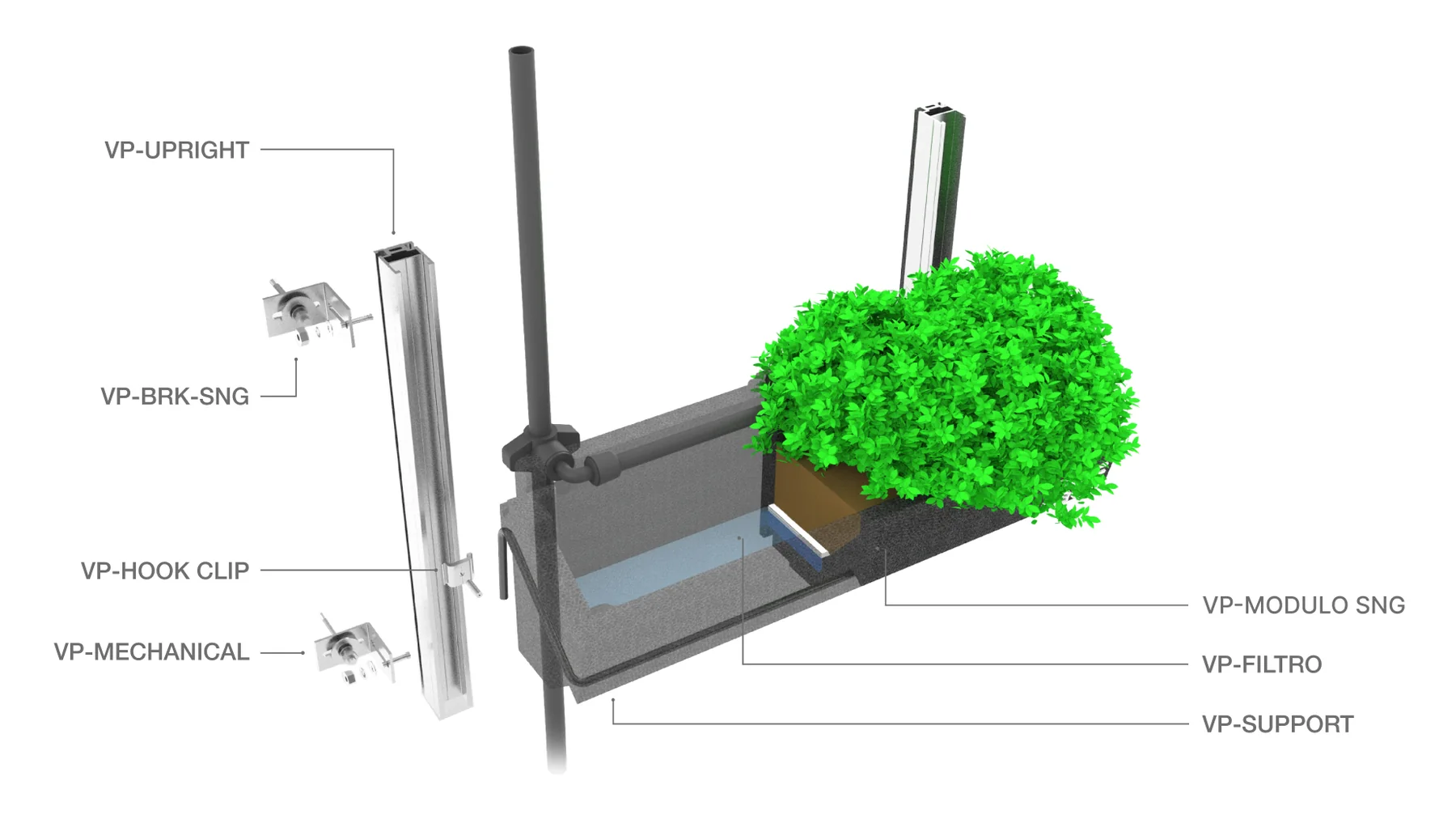
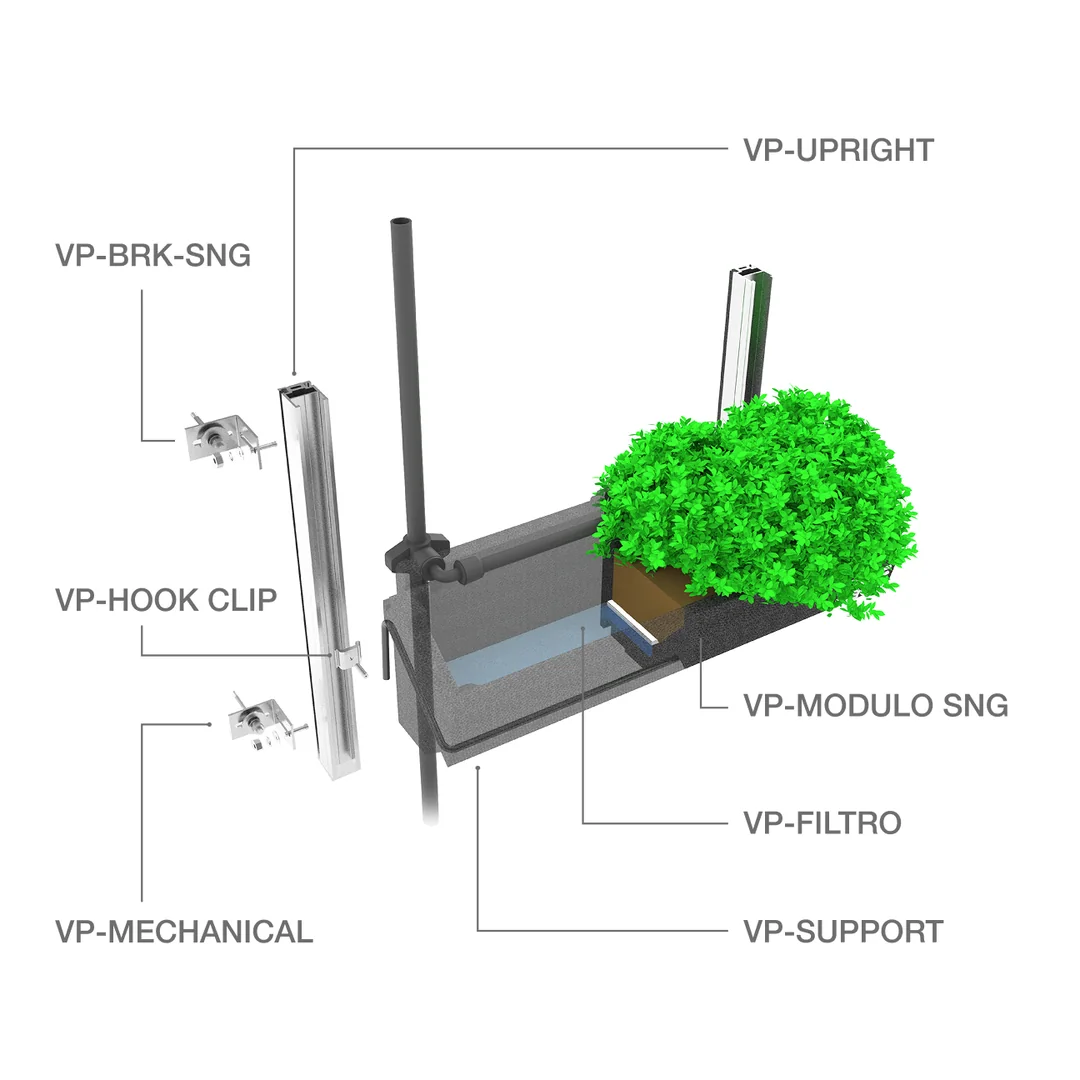
The load-bearing structure consists of EN AW 6060-T6 aluminum uprights up to 3 meters long, fixed to the wall with single or double brackets and steel anchors. Adjustable clips with an M6 set screw attach to the uprights: the height of each row of trays is set at the design stage, and this is what creates the different compositions.
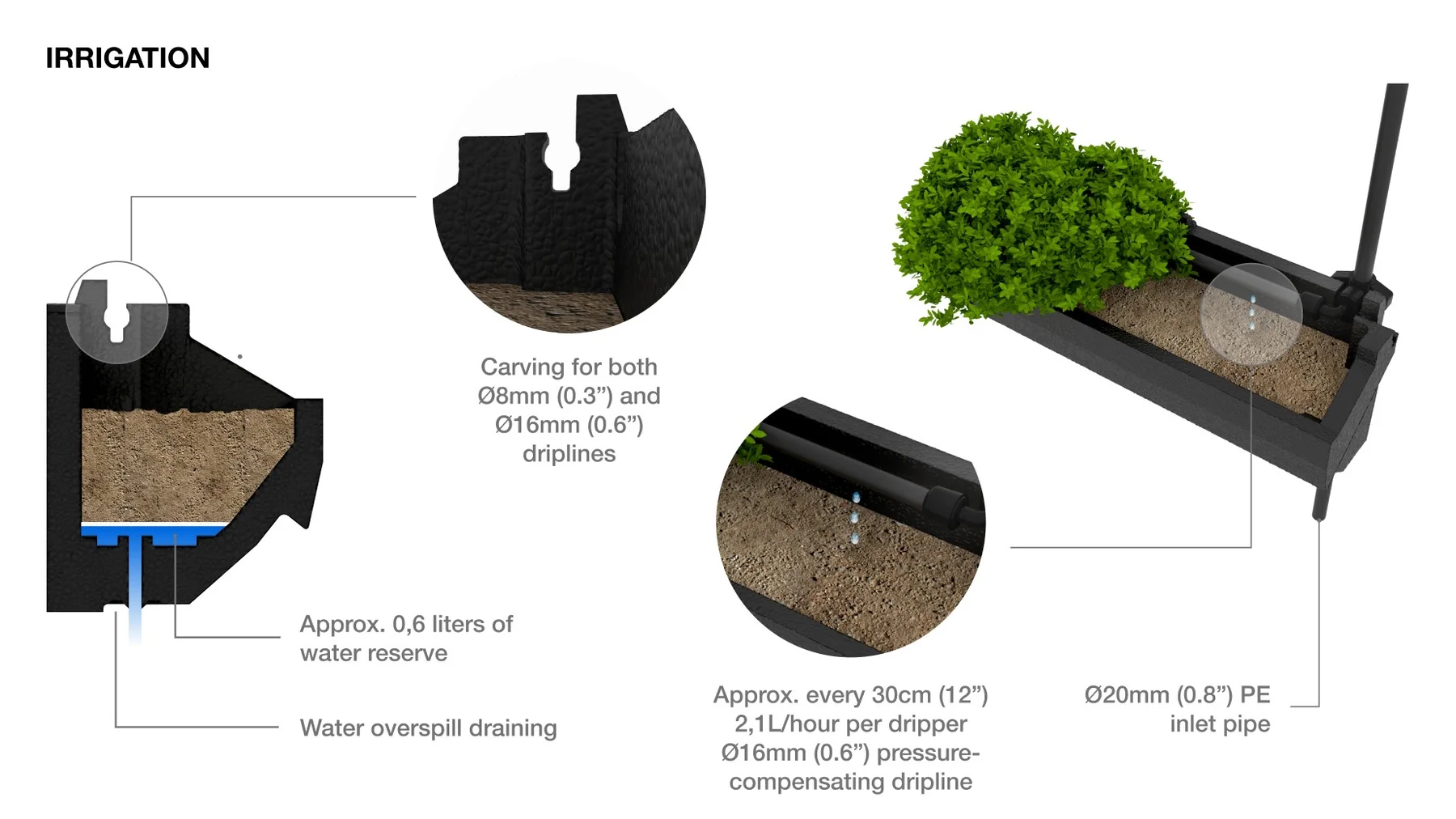
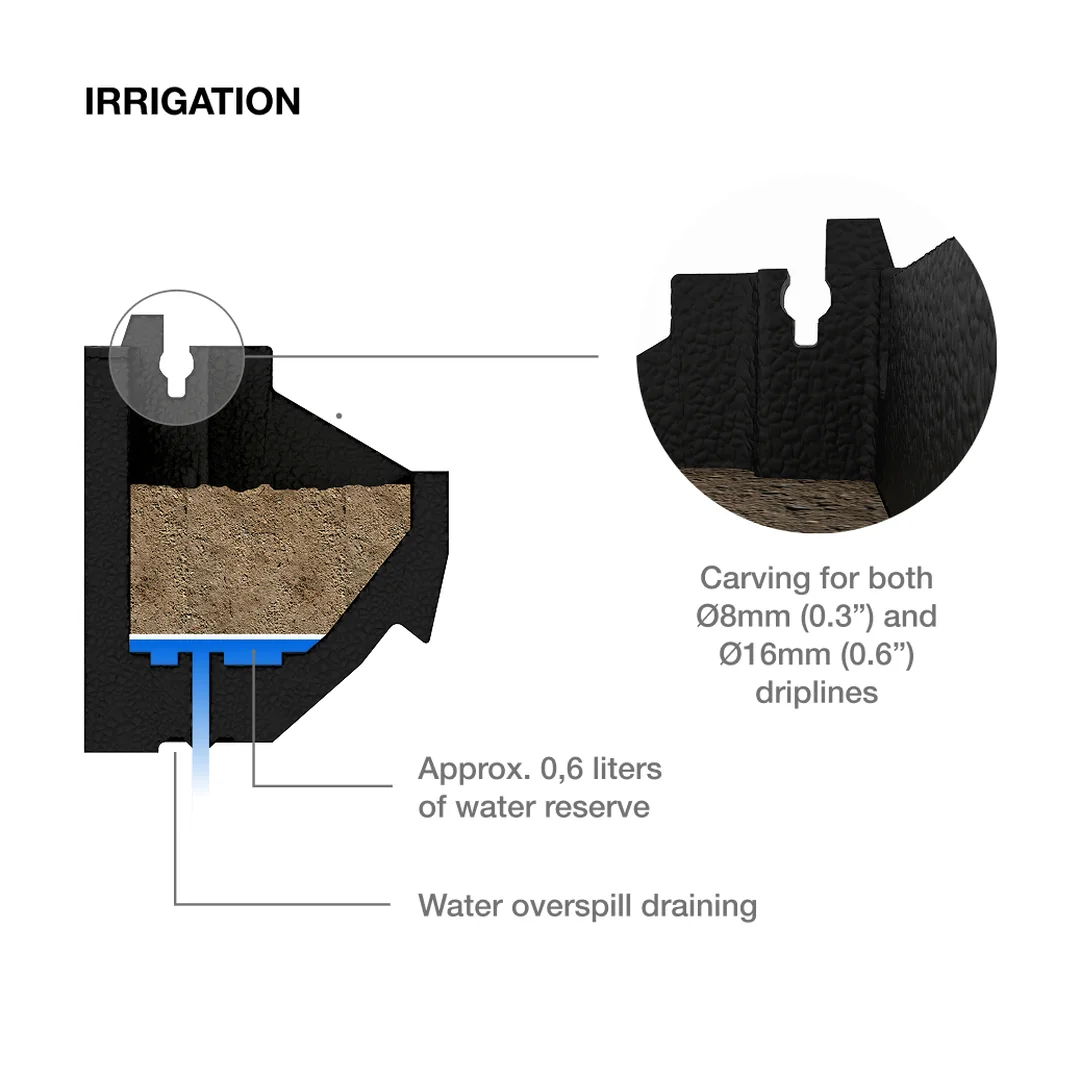
The tray is made of black EPP (expanded polypropylene). It weighs 0.37 kg, is up to 60 cm long, 17 cm deep and 19 cm high, and can be cut to size when a shorter length is needed. At the bottom it holds an independent water reserve of about 0.6 liters. EPP is lightweight, odorless, non-toxic and 100% recyclable, and thanks to its thermal insulation properties it protects soil and roots from temperature changes.
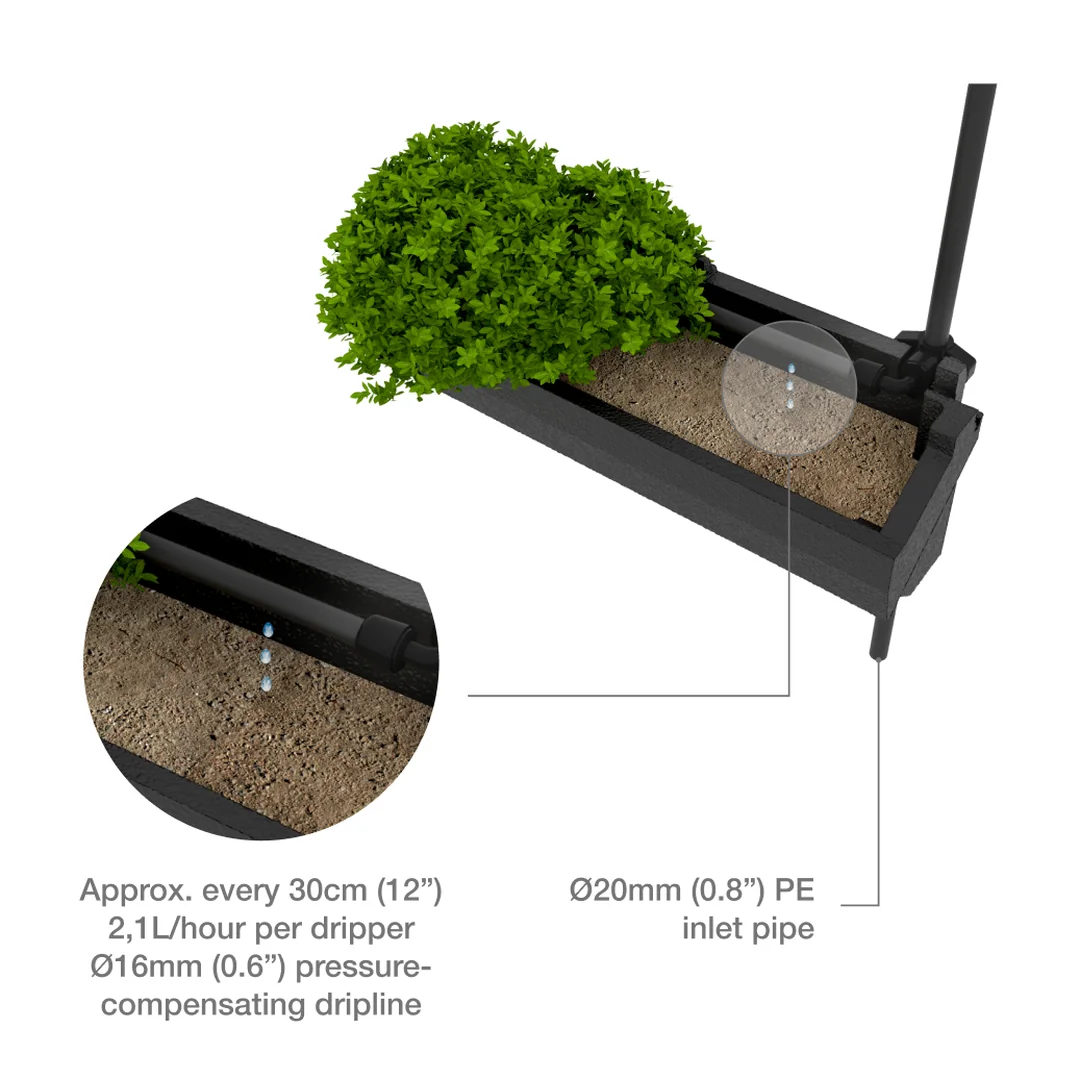
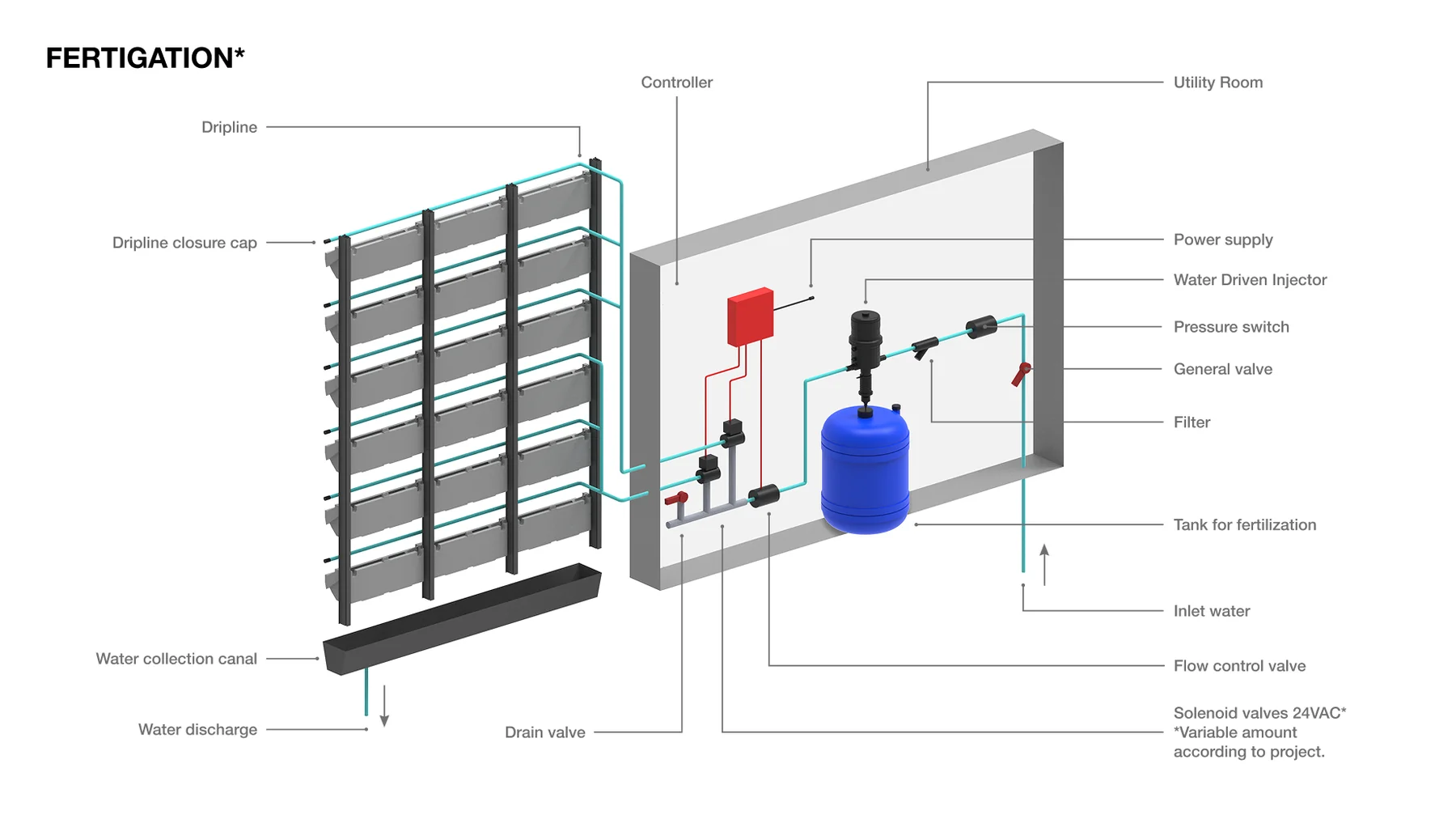
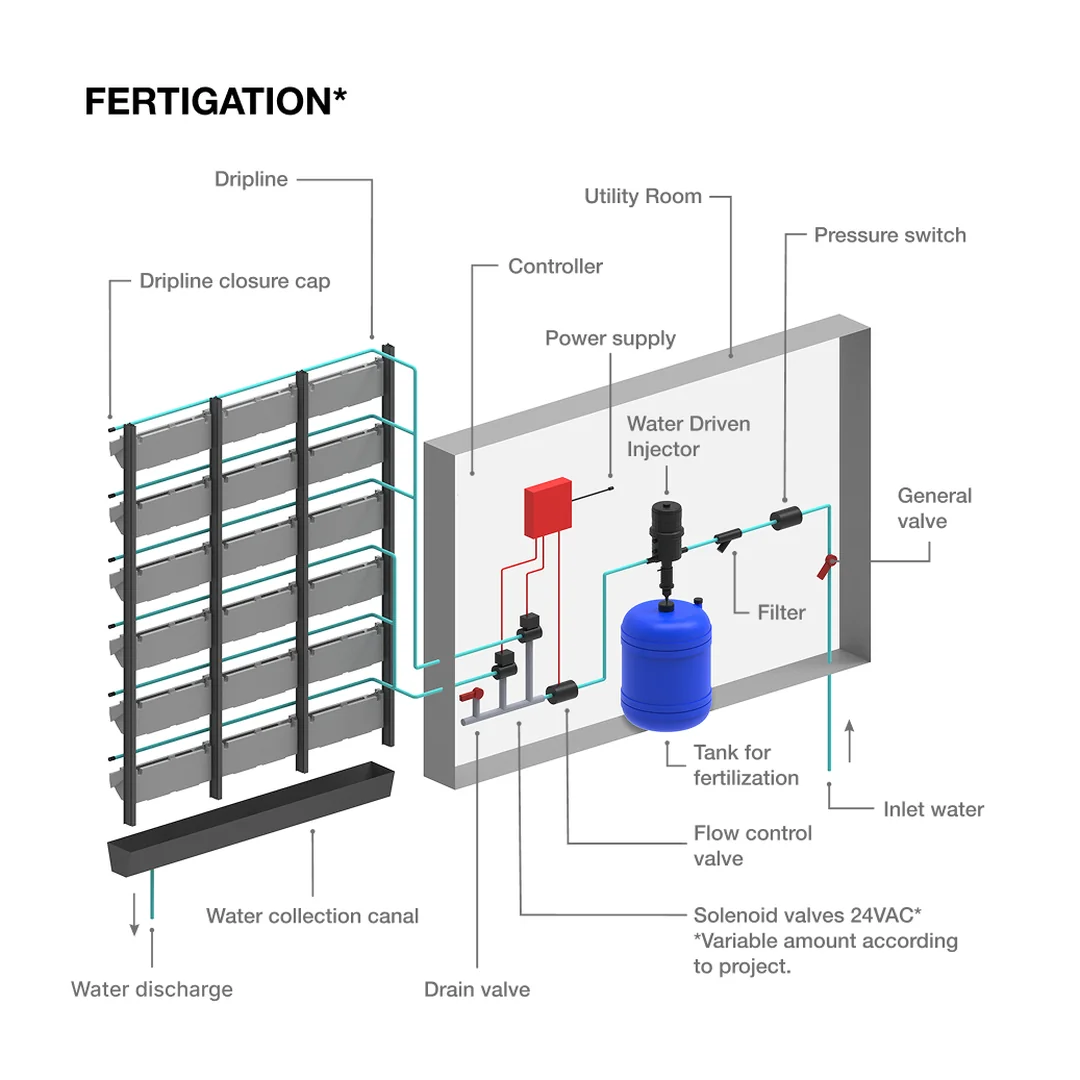
Irrigation is built into the system: a pressure-compensating dripline with a 16 mm diameter delivers water directly into each tray, with a dripper roughly every 30 cm and a flow rate of 2.1 liters per hour. Because it is pressure-compensating, the dripline delivers the same amount of water from the first to the last dripper, wherever the tray sits on the wall. Upstream, a fertigation system with a control unit manages frequency and dosage.
The available layouts are full, alternating, climbing and corner; the system is completed by the VP Modulo Thermopine, VP Modulo Tree Pot and VP Modulo Barrier accessories, shown in the Accessories section of this page.
VP Modulo key technical data
| Feature | Value |
|---|---|
| Patent | Modular system for vertical gardens, Nov. 2017 |
| Uprights | EN AW 6060-T6 aluminum, up to 3 m |
| Tray | Black EPP, L up to 60 cm · D 17 cm · H 19 cm |
| Tray weight | 0.37 kg |
| Water reserve per tray | approx. 0.6 liters |
| Indicative quantity | approx. 8 trays/m² |
| Irrigation | Pressure-compensating dripline Ø16 mm, 2.1 l/h approx. every 30 cm |
| Wall projection (without plants) | 23–26 cm |
| Recommended anchor spacing | 1.50 m |
| Indicative installation time | approx. 1 m²/hour, including plants, soil and irrigation |
Outdoor and indoor living walls: what to plan in the design
Outdoors, the system also performs in demanding climates: the insulating properties of EPP reduce heat and cold stress on the plants, and the use of soil makes it possible to choose local species already adapted to the site. The indicated water requirement is about 1.5 m³ of water per m² per year, based on Mediterranean European climate conditions. In case of frost, electrical components must be protected and the irrigation system drained.
Indoors, light is the decisive factor. A plant-growth lighting system is required, delivering 1,000–1,550 lux evenly, with a full light spectrum, on for at least 12–14 consecutive hours, using lamps rated at least IP44: as a guide, one lamp per linear meter of garden, 1.20 m from the wall. The recommended temperature is between 15 and 25 °C, avoiding direct air-conditioning flows, and the water requirement drops to about 0.3 m³ per m² per year. Where the wall has no water supply or drain, a collection tank with a circulation pump can be installed.
For correct operation, a pressure of 1.5 to 3 bar is required at the highest point of the garden, together with a utility room housing the control unit, solenoid valves, filter, fertilizer injector and pressure reducer, sized for each project. Excess water is collected beneath the wall. Suitable substrates are solid masonry, uncracked concrete or compact natural stone.
A green wall is a living element: it follows the seasons and needs regular checks, with pruning and cleaning scheduled during the plants’ dormant periods. We have collected the main guidelines in what to know about maintaining a vertical garden.
VP Modulo has undergone LEED® mapping: the technical sheet lists the credits the system can contribute to, including rainwater management, heat island reduction and indoor environmental quality. More on certified green solutions in why choose LEED, WELL and CAM certified green solutions. The technical sheets for the system and its accessories can be downloaded from this page; for layouts, irrigation sizing and design documentation, our technical office is at your disposal. Some VP Modulo installations are collected in our vertical garden projects.
Frequently asked questions about green wall systems
What structure does a green wall need?
With VP Modulo, the structure consists of EN AW 6060-T6 aluminum uprights up to 3 meters long, fixed to the wall with steel brackets and anchors. Adjustable aluminum clips with an M6 set screw attach to the uprights and hold the pot holders, made of 5 mm iron rod. Suitable substrates are solid masonry, uncracked concrete or compact natural stone, with a recommended anchor spacing of 1.50 m. Where the layout requires it, the uprights can also be mounted horizontally using dedicated 15 cm segments.
How many modules are needed per square meter of green wall?
With VP Modulo, about 8 trays are needed per square meter. Each tray is up to 60 cm long and can be cut to size to fit the wall. For a 4 × 3 meter wall, the technical sheet indicates a standard supply of about 100 trays. The exact number depends on the chosen layout: full, alternating, climbing or corner.
How is a green wall installed?
With VP Modulo, the brackets and vertical uprights are installed first, then the clips and pot holders at the heights set by the layout, and finally the trays with the irrigation line, soil and plants. The technical sheet indicates an installation time of about 1 m² per hour, including plants, soil and irrigation. Before installation, the layout, the wall substrate, the fertigation system and, indoors, the lighting must be defined at the design stage.
Can a green wall be installed indoors?
Yes, VP Modulo is suitable for both indoor and outdoor spaces. Indoors, a plant-growth lighting system is required, providing 1,000–1,550 lux evenly for at least 12–14 consecutive hours, with lamps rated at least IP44. The recommended temperature is between 15 and 25 °C, avoiding direct air-conditioning flows. Where the wall has no water supply or drain, a collection tank with a circulation pump can be installed.